
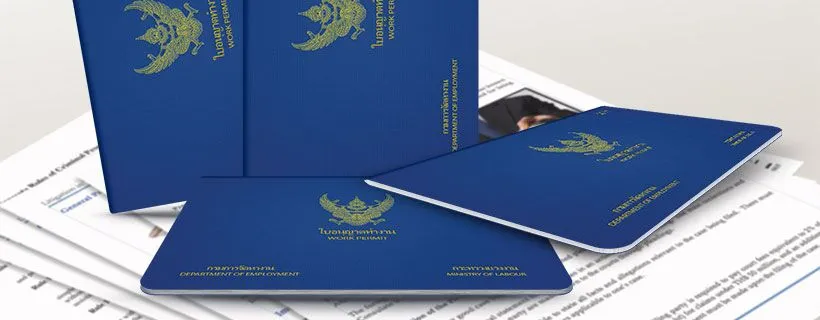
A Thai work permit is a legal authorization that allows a foreign national to work in Thailand in a specific role, for a specific employer, and at a specific location. Regardless of visa type or duration of stay, most foreigners who engage in employment or business activities in Thailand are required by law to obtain a valid work permit before commencing work. Failure to comply can result in serious penalties for both the employee and the employer.
This article provides a comprehensive and detailed explanation of Thai work permits, including the legal framework, eligibility requirements, application process, restricted occupations, compliance obligations, and practical considerations.
1. Legal framework governing work permits in Thailand
Thai work permits are regulated primarily by:
- The Emergency Decree on the Management of Foreign Workers B.E. 2560 (2017) and its amendments
- Related ministerial regulations and announcements
The law defines “work” broadly, covering not only formal employment but also any activity that uses knowledge, labor, or expertise for remuneration or benefit, regardless of payment source.
2. Who must obtain a work permit
Any foreign national who performs work in Thailand generally must have:
- A valid non-immigrant visa that permits work, and
- A valid work permit
This requirement applies even if:
- The work is unpaid
- The foreigner is paid from overseas
- The activity is short-term
There are limited statutory exemptions, but they are narrowly interpreted.
3. Relationship between visa and work permit
A visa allows entry and stay in Thailand, while a work permit authorizes employment.
Common visa types supporting work permits include:
- Non-Immigrant “B” (Business) Visa
- Non-Immigrant “IB” (Investment) Visa
- Certain Smart Visas
A tourist visa does not permit work or work permit issuance.
4. Definition of “work” under Thai law
The legal definition of work includes:
- Physical or mental labor
- Use of skills or expertise
- Services provided to an employer or business
Activities such as consulting, managing a company, or even volunteering may be considered work if they benefit an organization.
5. Employer eligibility requirements
Employers seeking to hire foreign workers must meet statutory criteria, including:
- Proper business registration
- Minimum registered capital
- Compliance with tax and labor laws
Typically, employers must maintain a prescribed ratio of Thai employees to foreign workers.
6. Capital and employee ratio requirements
As a general rule:
- Two million baht in registered capital per work permit is required
- Four Thai employees per foreign worker may be required
Exceptions may apply to:
- BOI-promoted companies
- Representative offices
- Certain specialized industries
7. Restricted and prohibited occupations
Thailand maintains a list of occupations reserved for Thai nationals. Foreigners are prohibited from engaging in these roles, including:
- Manual labor
- Retail sales
- Certain professional services
- Traditional crafts
Violations can lead to severe penalties.
8. Application process for a Thai work permit
Step 1: Obtain appropriate visa
The applicant must hold a visa that allows work permit application.
Step 2: Prepare documentation
Common documents include:
- Passport and visa
- Educational certificates
- Employment contract
- Company registration documents
All documents must be accurate and complete.
Step 3: File application
Applications are submitted to the Department of Employment or designated offices.
Step 4: Approval and issuance
Once approved, the work permit specifies:
- Employer
- Job description
- Workplace location
Work may commence only after issuance.
9. Validity and duration of work permits
Work permits are usually issued for:
- Up to one year
- Corresponding to visa validity
Renewals must be filed before expiration to avoid penalties.
10. Conditions and limitations of a work permit
A work permit strictly limits:
- Job title and duties
- Employer
- Workplace
Any change requires amendment approval before implementation.
11. Changes to employment conditions
Changes requiring amendment include:
- Employer change
- Job role modification
- Workplace relocation
Unauthorized changes constitute illegal employment.
12. Digital work permits
Thailand has implemented electronic work permits in some cases, reducing reliance on physical booklets while maintaining compliance obligations.
13. Penalties for non-compliance
Violations may result in:
- Fines
- Imprisonment
- Deportation
- Blacklisting
Employers also face penalties for hiring unauthorized workers.
14. Work permits for business owners and directors
Foreign directors or shareholders actively managing a company generally require a work permit, even if they are not salaried employees.
Passive shareholders do not require work permits.
15. BOI and special category work permits
Companies promoted by the Board of Investment (BOI) may:
- Employ foreigners more flexibly
- Benefit from streamlined procedures
Certain professionals may qualify for special exemptions.
16. Work permits and family members
A work permit does not automatically extend to family members. Dependents require separate visas and are not authorized to work unless they obtain their own permits.
17. Cancellation and termination
Work permits must be canceled when:
- Employment ends
- The foreigner leaves Thailand permanently
Failure to cancel may cause future immigration issues.
18. Practical compliance considerations
Foreign workers should:
- Carry work permit details
- Adhere strictly to permitted duties
Employers should:
- Monitor permit validity
- Ensure accurate job descriptions
19. Common misconceptions
Frequent misunderstandings include:
- Believing a business visa allows work without a permit
- Assuming unpaid work is permitted
- Thinking short-term work is exempt
These assumptions often lead to violations.
20. Conclusion
The Thai work permit system is a central component of Thailand’s labor and immigration control framework. It ensures that foreign employment aligns with national economic policy while protecting the local workforce.
For foreign nationals, a valid work permit is not merely a formality but a legal necessity that defines the scope of permissible activities. For employers, compliance with work permit regulations is essential to avoid penalties and operational disruption. Careful planning, accurate documentation, and ongoing compliance are key to lawful and successful employment in Thailand.