
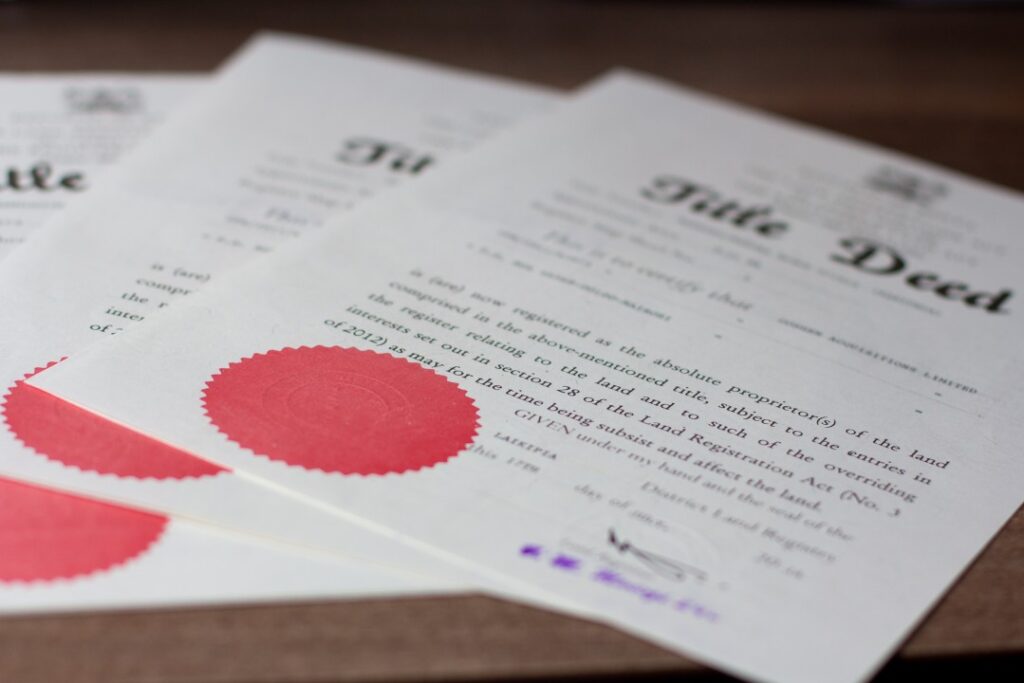
Title Deeds in Thailand. Property ownership in Thailand is governed by a structured land registration system designed to establish legal ownership, define land boundaries, and protect property rights. Central to this system is the title deed, a legal document issued by the government confirming a person’s ownership or rights over a parcel of land.
Understanding title deeds is essential for anyone involved in buying, selling, leasing, or investing in real estate in Thailand. The country recognizes several different types of land documents, each providing varying degrees of ownership rights and legal security.
For foreign investors and property buyers, the type of title deed attached to a property significantly affects the legality of the transaction, the ability to transfer ownership, and the potential risks involved.
This article provides a detailed overview of title deeds in Thailand, including their legal framework, the different types of title documents, the role of land authorities, and the importance of conducting proper title searches before purchasing property.
Legal Framework Governing Land Ownership
Land ownership and title registration in Thailand are regulated primarily under the Land Code of Thailand, which establishes the legal system for land administration, ownership rights, and land registration procedures.
The government agency responsible for land registration and issuance of title deeds is the Department of Lands Thailand, which operates under the Ministry of Interior.
The Department of Lands maintains official records of land ownership, issues title deeds, registers property transfers, and records mortgages, leases, and other legal interests in land.
These official records serve as the primary legal evidence of ownership in Thailand.
Importance of Title Deeds
Title deeds play a critical role in property transactions because they provide legal confirmation of land ownership and establish the rights associated with the property.
A properly issued title deed confirms several important aspects of land ownership, including:
- The legal owner of the property
- The size and boundaries of the land
- The official location of the property
- Any registered encumbrances such as mortgages or leases
Without a valid title deed, it may be difficult or impossible to prove ownership rights or transfer property legally.
For this reason, verifying the authenticity and type of title deed is one of the most important steps in any real estate transaction in Thailand.
Major Types of Title Deeds in Thailand
Thailand recognizes several categories of land documents, each representing different levels of ownership rights and legal certainty.
The most commonly encountered land documents include Chanote, Nor Sor 3 Gor, Nor Sor 3, and Sor Kor 1.
Chanote (Nor Sor 4 Jor)
The Chanote title deed is the highest form of land ownership recognized in Thailand.
A Chanote deed provides full ownership rights and allows the owner to:
- Sell the property
- Lease the land
- Mortgage the property
- Transfer ownership freely
Land under a Chanote title deed has been fully surveyed by government officials using precise GPS coordinates, and its boundaries are clearly marked with official survey markers.
Because of its legal certainty and clearly defined boundaries, Chanote land is considered the most secure form of land ownership in Thailand.
Most urban properties and condominium developments are built on Chanote land.
Nor Sor 3 Gor (N.S.3.K)
The Nor Sor 3 Gor title is another relatively secure land document, though slightly less definitive than a Chanote.
This document certifies that the land has been surveyed and confirmed by government authorities, but the boundaries may not be marked by permanent survey markers.
Landowners holding Nor Sor 3 Gor titles have the right to:
- Sell or transfer the land
- Register leases or mortgages
- Upgrade the title to a Chanote in many cases
While still considered a legitimate form of ownership, buyers often seek to convert Nor Sor 3 Gor titles into Chanote titles for greater security.
Nor Sor 3 (N.S.3)
The Nor Sor 3 title deed provides a lower level of land ownership certainty compared to Chanote and Nor Sor 3 Gor.
Unlike Chanote land, Nor Sor 3 land may not have been accurately surveyed using modern mapping systems.
Boundaries may be described based on neighboring plots rather than precise coordinates.
While Nor Sor 3 land can be transferred, buyers must exercise caution because boundary disputes may arise if land measurements are not clearly defined.
In some cases, Nor Sor 3 land can be upgraded to higher title classifications through official surveying procedures.
Sor Kor 1
The Sor Kor 1 document is not technically a title deed but rather a certificate of land possession.
It indicates that the holder occupies the land but does not necessarily provide full legal ownership rights.
Because Sor Kor 1 land has not been formally surveyed or registered as privately owned property, it cannot be sold legally in the same way as land with a Chanote or Nor Sor title.
In some cases, holders of Sor Kor 1 documents may apply to upgrade their land status to a higher title classification, but this process can be lengthy and uncertain.
For most property investors, Sor Kor 1 land presents significant legal risks.
Title Deed Information and Registration Details
Thai title deeds contain several important pieces of information that define the legal characteristics of the land.
Typical details included in a title deed are:
- Title deed number
- Owner’s name
- Land size measured in rai, ngan, and square wah
- Land location and district
- Official survey map of the property
- Boundary markers and coordinates
Title deeds also include records of registered legal transactions such as mortgages, leases, or servitudes affecting the property.
These records help ensure transparency in property ownership.
Property Transfers and Registration
Property transfers in Thailand must be officially registered at the local land office.
The transfer process usually involves:
- Verification of the title deed
- Signing of transfer documents by the buyer and seller
- Payment of government fees and taxes
- Registration of the new owner in the official land records
Once the transfer is completed, the buyer’s name is recorded on the title deed, confirming legal ownership.
Failure to register the transfer with the land office may result in disputes over ownership.
Title Search and Due Diligence
Before purchasing property in Thailand, it is essential to conduct a title search at the land office.
A title search verifies several important details, including:
- The identity of the current landowner
- Whether the property is subject to mortgages or liens
- Any registered leases or servitudes
- Whether the property boundaries are legally recognized
Conducting proper due diligence helps protect buyers from potential legal disputes or fraudulent property transactions.
Foreign Ownership Restrictions
Thailand has strict laws regarding foreign ownership of land.
Foreign nationals generally cannot own land directly in Thailand. However, they may acquire property through certain legal structures such as condominium ownership under the Condominium Act B.E. 2522.
Foreign investors may also use long-term lease agreements or corporate structures to secure property interests, depending on the circumstances.
Because of these restrictions, understanding the type of title deed associated with a property is especially important for foreign buyers.
Common Risks in Property Transactions
Real estate transactions in Thailand may involve several risks if proper due diligence is not conducted.
Common issues include:
- Unclear land boundaries
- Fraudulent title documents
- Undisclosed mortgages
- Disputes over land access rights
Working with experienced legal professionals can help ensure that title deeds are verified and property transactions comply with Thai law.
Importance of Legal Assistance
Because property laws and title classifications can be complex, many buyers seek legal assistance when purchasing land or real estate in Thailand.
Legal professionals can assist with:
- Conducting title searches
- Verifying ownership documents
- Reviewing property contracts
- Ensuring compliance with foreign ownership laws
Professional legal guidance can significantly reduce the risks associated with property transactions.
Conclusion
Title deeds are the foundation of property ownership in Thailand. They establish legal rights, confirm land ownership, and provide the official documentation required for transferring property.
Different types of title deeds provide varying levels of legal security, with Chanote titles offering the highest level of ownership certainty. Other land documents such as Nor Sor 3 Gor and Nor Sor 3 provide recognized ownership rights but may require additional verification.
For property buyers and investors, understanding the distinctions between these title types is critical. Conducting proper due diligence, including a title search and verification of land records, helps ensure that property transactions are legally valid and secure.
With Thailand’s growing real estate market and increasing foreign investment, a clear understanding of title deeds and land ownership laws remains essential for anyone involved in property transactions in the country.